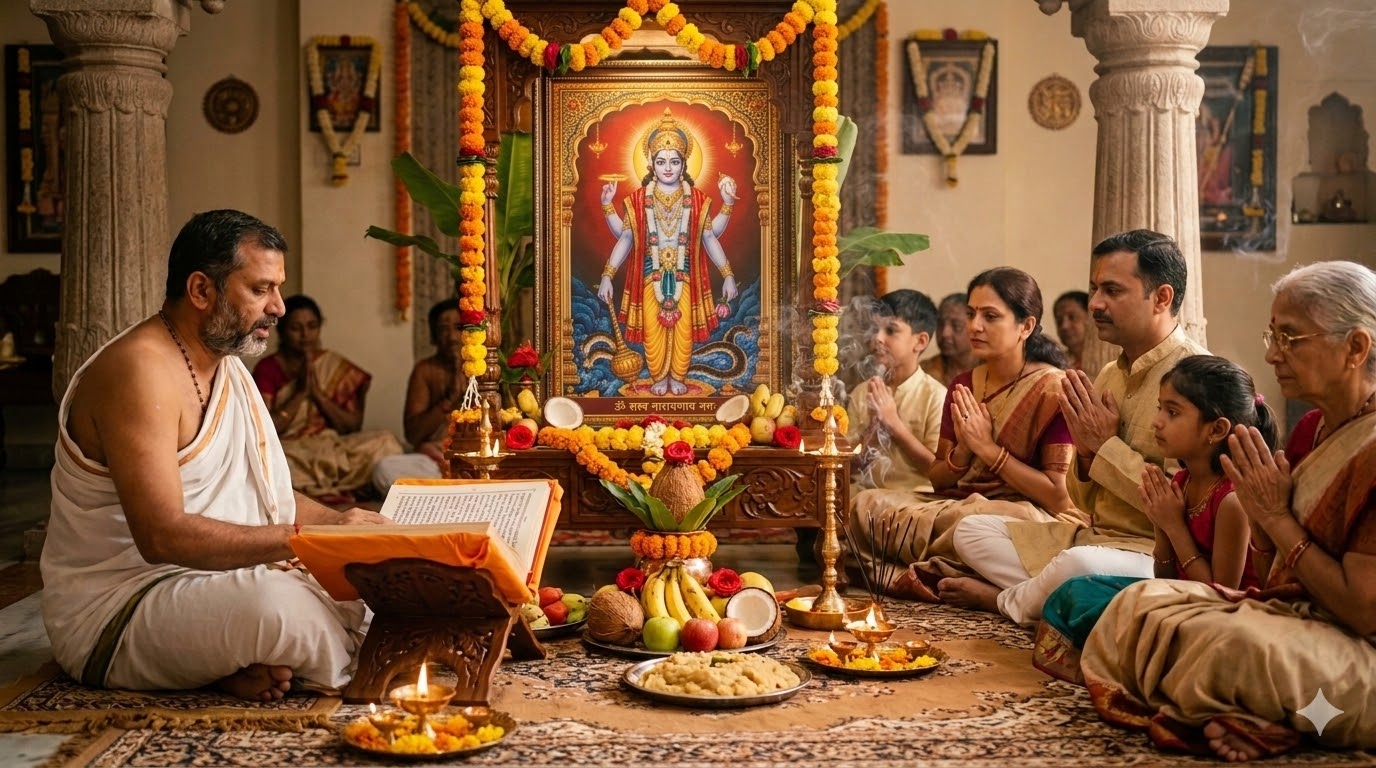
What Is This Puja? Most people enter a new home with excitement. The Vedic tradition asks you to enter it with awareness — awareness of the energies that reside in built space, of the debt owed to the earth on which the structure stands, and of the divine protectors who must be formally invited before the household gods take residence. Griha Pravesh is one of the sixteen domestic sacraments (Grihyasamskaras) described in the Paraskara Grihyasutra. It is not a ritual of good luck — it is the formal procedure by which a space transitions from being a structure to being a griha: a place of dharmic household life. The Vastu Shastra tradition describes the Vastu Purusha — a cosmic being whose body is mapped onto the plot and structure. Entering without propitiating Vastu Purusha is not superstition; it is occupying a space whose presiding energies have not been formally acknowledged.
Approx. Duration
Primary Deity
What Is This Puja? Most people enter a new home with excitement. The Vedic tradition asks you to enter it with awareness — awareness of the energies that reside in built space, of the debt owed to the earth on which the structure stands, and of the divine protectors who must be formally invited before the household gods take residence. Griha Pravesh is one of the sixteen domestic sacraments (Grihyasamskaras) described in the Paraskara Grihyasutra. It is not a ritual of good luck — it is the formal procedure by which a space transitions from being a structure to being a griha: a place of dharmic household life. The Vastu Shastra tradition describes the Vastu Purusha — a cosmic being whose body is mapped onto the plot and structure. Entering without propitiating Vastu Purusha is not superstition; it is occupying a space whose presiding energies have not been formally acknowledged.
The householder (yajamana) and spouse declare formal intent — gotra, nakshatra, date, location, type of Griha Pravesh, and deities to be invoked. Without sankalpa, a puja has no specific beneficiary in the Vedic framework.
Ganesha worshipped with sixteen offerings from avahana to visarjana. Ganapati Atharvashirsha recited. A fresh coconut broken at the threshold — the divine guest's first act of entry.
Purification of the space through sacred water and Varun mantras. The purohit purifies cardinal points, threshold, puja room, and kitchen using kalash water, mantras, and darbha grass — the Vedic consecration of space.
Nine earthen pots representing the Navagraha arranged and worshipped. Each planet receives its specific mantra, flower, grain, and colour in traditional order beginning with Surya.
The Vastu Mandala is drawn on the floor. Offerings made to the 45 or 81 devatas presiding over different sectors. In the Premium vidhi, a homa is performed within the home for Vastu Shanti.
The housewife enters first, lit lamp in right hand, pot of rice in left. She crosses with the right foot first while Sri Sukta is chanted. This is the ceremonial moment of home establishment.
Lakshmi formally established in the puja room. Sacred Kalash placed, household lamp lit, family deity image installed. This is the establishment of griha devata — the divine resident of the home.
Your lineage deity invoked through gotra-specific mantras. SiddhiStar asks for your gotra and lineage at booking to ensure the correct invocation. Most platforms skip this step entirely.
Deities thanked and bid farewell. Purohit receives dakshina and gives ashirvad to the family. First meal in the new home is ideally pongal, khichdi, or sweet rice.
All Samagri
Pooja is a traditional Vedic ritual performed as per established procedure. It is not a substitute for medical, legal, or professional treatment. SiddhiStar does not guarantee specific outcomes